
Checking a Firearm Recall Notice Against Your Own Records
While a recall notice may stand out from other alerts and newsletters, it can easily get lost in cyber space. The notifications that notify owners of a recall need to be retrieved from databases and records to ensure that the correct owners and corresponding firearms are contacted. This simple check of records can aid owners […]
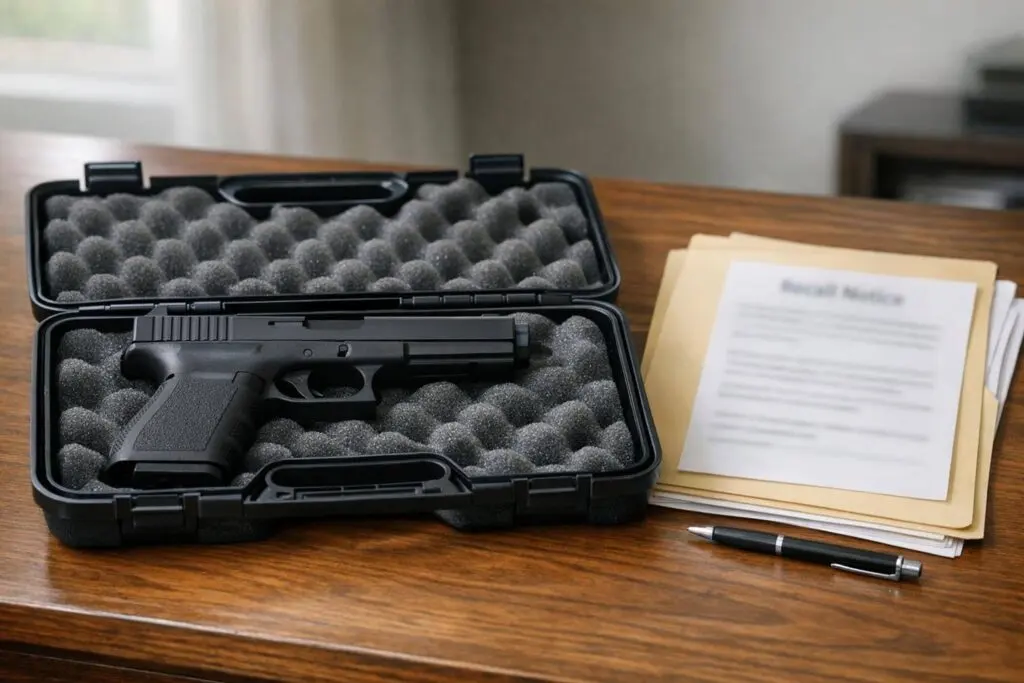
While a recall notice may stand out from other alerts and newsletters, it can easily get lost in cyber space. The notifications that notify owners of a recall need to be retrieved from databases and records to ensure that the correct owners and corresponding firearms are contacted. This simple check of records can aid owners in determining whether or not a notice pertains to them, and facilitate a halt to use of the firearm pending verification and/or additional information from the manufacturer.
Start with the firearm, not the headline
Announcements can cover wide model ranges, production time periods, parts or even whole serial numbers. Announcements can refer to a model name which may look very similar to the marking found on your firearm, but not be identical, e.g. model names that have been used for different model variants over the years. There could be different generations, different cosmetic finishes, different calibers, etc.
1. Begin with the firearm unloaded and in a safe location. Follow the basic steps of verifying that it is unloaded as outlined by the manufacturer of the firearm. Keep the ammunition for the firearm separate from the firearm until you are satisfied that the firearm is unloaded. Do not attempt to disassemble the firearm to search for a serial number or other marking unless so instructed by the manufacturer in written instructions to do so for purposes of verifying the existence of a marking.
Make sure to write down all of the information with exact spelling, i.e. manufacturer, model name, serial number, calibre, and type of variant marking. A clear photograph of the marking can also be helpful in transcribing the information, but make sure to protect the image in case it contains information that you would not like to distribute publicly.
Make the serial number readable before comparing it
Look closely at the letters and numbers. Can they be read from the same angle? Are there any characters that have worn away or have been covered up by finish. If necessary make a copy of the characters and compare them to records such as purchase receipts, transfer documents, warranty, owner's manuals, service records and maintenance records.
Be accurate when writing down the marking as you would in a search engine query. Do not add spaces between characters, remove a prefix from a model number, or replace similar-looking characters. It is possible that the manufacturer intended to use a different marking and that it was not properly applied. Record any uncertainty regarding the marking and ask the manufacturer how it will be used to verify the recall.
Refuse to post the complete serial number on a public forum, even when seeking assistance with identifying an announcement. The public discussion may assist in locating the proper announcement; however, the final verification with the manufacturer or authorized service center must be done with the proper information to establish ownership.
Pull together the records you already have
Before you need to check a firearm for a recall, start making records for all of your firearms before there is a problem with them. Gather together the purchase receipt, owner's manual, warranty correspondence, service invoices, and all previous maintenance records and notes, especially those that list out parts that were replaced.
Documentation can be as simple as listing the firearm manufacturer, model, and serial number, along with the date it was purchased, from whom it was purchased, and any records of maintenance, repair or replacement of parts. The information should be kept safe from others, but a back-up of the information kept in a safe location. Records requirements vary by location and by documentation for local firearms so check the most current information for these items.
In many cases the owner will not have the original receipt. However, it is usually possible to verify a firearm for a recall by referencing the manufacturer markings on the firearm itself, in conjunction with the manufacturer's safe use instructions or other relevant documentation for that model.
Read the notice for the actual remedy
There is typically much more to a recall notice than the opening warning. Take the time to read the entire notice to determine the specific model(s) being affected, the serial number range(s), the specific problem(s), and what the manufacturer is advising owners to do with affected firearms. Will owners be directed to stop using affected firearms until they are inspected and repaired? Will they need to return a part to the manufacturer? Will owners be directed to contact a specific service department for inspection and repair?
Again, don't make the assumption that because your firearm looks similar to the ones on the list that it must also be included. Conversely, just because your firearm never exhibited any problems, don't assume that it must therefore not be included on the recall. Many potential problems are not immediately apparent and require specialized testing to uncover. Such is the basis for the recall in the first place.
Be cautious of the notice's wording. A notice may say to cease use of a firearm. If so, then treat the firearm as if it were unloaded and store it in a locked cabinet or safe. Do not use the firearm for target practice. Seek service or guidance from the manufacturer's authorized service provider(s). Do not attempt to make repairs or to alter the firearm in some manner to try to fix a problem not yet apparent.
Resolve uncertainty through official verification
When asking official verification questions regarding a firearm recall, make sure to ask the most relevant questions and include relevant model information and even quotes of written notice text. Also, ask for documentation requirements for inspections or to have components replaced. Always verify that you are speaking with an official manufacturer representative.
Use contact information from the notice, current official manufacturer material or documentation supplied with the firearm. Don't trust a message that asks for any form of payment, for credentials or other sensitive personal information before telling you how to address any safety issues with your firearm. Keep a copy of any correspondence and be sure to note the date and all contacts made and with whom.
All requirements for the shipping, transfer, storage and service of firearms, such as special forms or area-specific restrictions, are subject to change. Refer to the manufacturer's website or local authorities for the most current information.
Turn the check into a repeatable habit
Finally, maintain a firearm record or log for all of your firearms. Update this record each time you receive notification of a recall, compare a firearm to a notice, inspect a firearm for damage, maintain or repair a firearm, etc. Keep a record of all notices received, all work orders for repairs or maintenance, and the date and person who performed any services on a firearm.
This simple pre-range exercise should include a review of current manufacturer recalls, confirmation that all of a shooter's firearms' documentation is readily to hand and that all seem to be in good condition (obvious damage etc.) and to look at all of the guns that will be shot that day and check for any obvious sign of damage or unusual deterioration etc. Note that this simple pre-range exercise should be in addition to manufacturer advice and general gun safety.
Records can provide modest value but almost certainly provide greater value than they cost in terms of helping to determine whether a given firearm is covered by a given notice and to respond accordingly.